
XML vs HTML: What’s Better For Structured Publishing
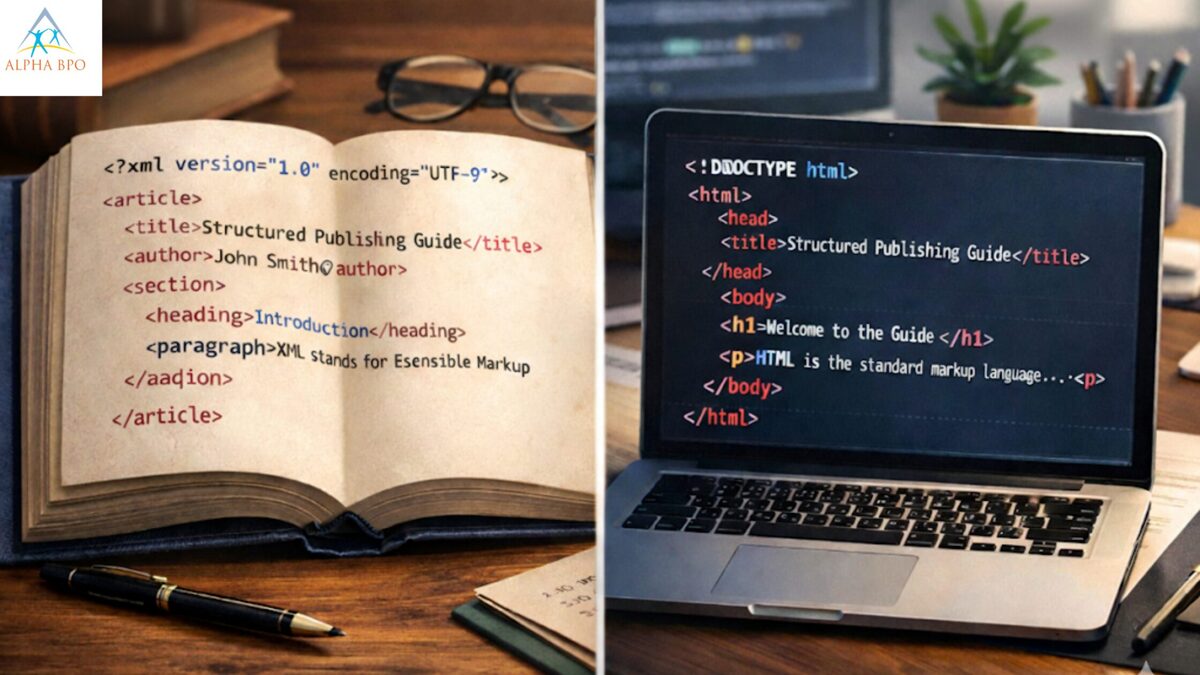
For most website developers, deciding between XML and HTML for publishing data and content online is challenging. However, enterprises handle large volumes of digital information that should be managed, stored, organized, and published effectively in a demanding content-driven environment.
Structured publishing plays a decisive role in managing content across different platforms, ranging from technical manuals and books to research documents and product catalogs. Selecting the right format is necessary for long-term usability.
Many institutions rely on professional XML conversion services to prepare their content for structured publishing, but HTML is also widely used as a markup language. Understanding the differences between XML and HTML can help you decide which option fits your publishing needs. This blog provides a clear idea about choosing HTML and XML for structured publishing.
The Significance Of Structured Publishing
A structured publishing process focuses on organizing content in a unique way that separates information from its design. Rather than developing separate versions for mobile, web, and print, structured content lets you organize information once and publish it across different formats.
This proactive approach increases uniformity, reduces manual work, and makes content easier to update. For this reason, both XML and HTML support digital publishing, but they serve different purposes and provide different levels of control.
A Brief Overview of XML
Extensible markup language, or XML, is designed to securely store and transport data in a structured and meaningful way. Unlike HTML, XML does not focus on the appearance of content. Instead, it defines what the content represents.
You can develop custom XML tags that perfectly describe the structure of your content. For instance, tags can identify titles, product specifications, chapters, or author details. This process makes XML highly flexible and suitable for difficult publishing projects.
One of the remarkable benefits of XML is its support for content reuse. A single XML file can be converted into multiple formats using data conversion services, including web pages, ebooks, PDFs, and mobile layouts.
This function makes it a strong choice for organizations that handle large content libraries and require frequent updates. Enterprises often use XML data conversion to turn existing documents into structured XML files. After conversion, the content becomes easier to find, search, manage, and repurpose across different platforms.
A Short Insight Into HTML
HyperText Markup Language, or HTML, is the standard language used to develop web pages. Its primary purpose is to display content in a browser and control how that content appears to users. The HTML uses predefined tags to structure texts, images, multimedia elements, and links.
This markup language focuses on presentation and layout instead of detailed content structure. For example, HTML defines tables, headings, and paragraphs, but it does not provide detailed meaning about the information itself.
HTML works well for online content and websites where user experience and visual presentations are the primary priorities. It is widely supported, simple to use, and ideal for publishing content that does not need complex structuring.
Primary Parameters Of Differences Between HTML and XML
Flexibility
XML enables you to develop custom tags according to your content requirements. This flexibility makes it a suitable option across multiple industries, including technical documentation, manufacturing, publishing, legal services, and healthcare. In contrast, HTML uses fixed tags, which limit its ability to represent complex data structures.
Function and Purpose
The most critical difference between HTML and XML lies in their purposes. HTML is created to display content, whereas XML is especially designed to organize and store data.
XML is the better option if your primary objective is multiple-channel publishing and structured content management. HTML format works perfectly when you only need to highlight content on a website.
Maintenance And Updates
Updating XML content becomes easier because the structure is distinct from the design. Changes can be made once and applied across all formats. HTML updates often require editing individual pages, which can take longer when managing large volumes of content.
Content Reusability
XML supports content reuse across different formats, which increases your business efficiency. After the content is stored in XML, it can be converted into different outputs without rewriting it. On the contrary, HTML content is typically created for a single purpose and often needs manual changes for different platforms.
When To Select XML For Structured Publishing
XML is a strong option when your organization handles large amounts of content that need to be published, reused, and updated across multiple channels. This format is especially useful for multiple things, such as:
Compliance and legal documents.
Digital publishing and eBook.
Technical Documentation.
Product catalogs and manuals.
Academic and research publishing.
Many companies thoughtfully invest in conversion to XML format to modernize their content workflows. Structured XML helps improve uniformity, reduce errors, and support long-term content management.
When HTML Is The Better Option
HTML is ideal for critical situations where the primary objective is to showcase information online rather than managing large content volumes. It works best for different tasks, such as:
Simple articles and web-based resources.
Blogs and website pages.
Marketing content and landing pages.
For institutions that want to publish content on the web only and do not require multi-format output, HTML is an effective, simple solution.
The Decisive Role Of Professional Conversion Solutions
Many businesses already have content stored in secure Word files, outdated legacy systems, and PDFs. Manually converting this content to XML or HTML can be time-consuming and error-prone.
Professional data conversion services help institutions efficiently process large volumes of content while maintaining accuracy and structure. These services support different formats and confirm that creative content meets higher publishing standards.
If you need document conversion for web publishing and structured XML for multi-channel distribution, professional, customizable solutions can align the process and minimize operational efforts.
Find The Perfect Selection For Structured Publishing Between XML and HTML Using XML Conversion Services
Both XML and HTML play vital roles in digital publishing, but they serve different requirements. HTML is the perfect choice for presenting content online. In contrast, XML offers a powerful solution for structured publishing, content reuse, and multiple platform distribution.
If your institution manages large volumes of information or plans to deliver content across different channels, XML offers long-term value and greater flexibility. Partnering with trustworthy data conversion services can further simplify the movement by confirming your content is accurately uniform, structured, and ready for scalable publishing. By selecting the right format and support, you can develop a workflow that is efficient, easy to manage, and future-ready as your content grows.