
Preparing Peel and Reveal Label Artwork For Error-Free Prepress Workflow
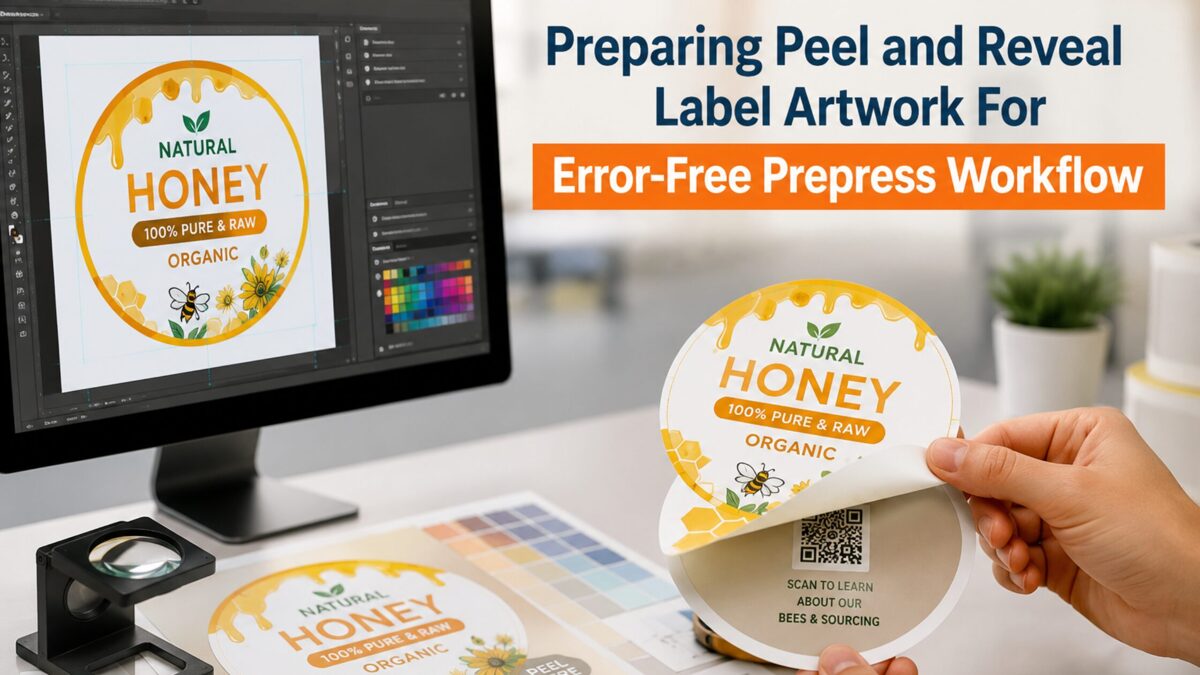
The ongoing adoption of modern tools and technologies in the printing industry enables designers to deliver high-quality print and label designs. The peel-and-reveal label may seem simple, but creating the right peel-and-reveal artwork for this type is quite complex. Any mistake in the file can lead to defects, delays, material losses, and increased printing costs.
That is why businesses turn to professional prepress services to ensure artwork is prepared correctly. No matter whether you produce pharmaceutical, food, cosmetic, or other industrial labels, accurate artwork preparation helps prevent errors and ensures proper label operation.
According to the Smithers report, the global label market is growing due to the emerging need for premium packaging and product information. This blog examines how to prepare peel-and-reveal label artwork for an error-free prepress workflow.
Why Peel and Reveal Labels Need To Be Treated Differently
Unlike conventional labels, print-and-reveal labels consist of several layers. These labels have extra space for product instructions, legal details, promotional information, safety notes, multilingual information, and more.
Peel-and-reveal labels must open and reseal repeatedly without damaging the printed layers.
Since the label has multiple layers, each part must line up properly. The graphics, text, adhesive areas, fold lines, and cutting lines all have to work together.
Even a minor alignment issue can cause the label to stop working properly. Artwork preparation for these labels is much more detailed than preparing a standard product label. Every artwork file should undergo a final technical review before production.
Multi-Layer Label Artwork
Proper creation of multi-layer label artwork starts with understanding how each layer interacts with the others. A standard peel-and-reveal label includes the following:
Protective varnishes or laminates.
Release coatings.
Base labels.
Adhesive areas.
Internal information panels.
An outer printable layer.
Each layer of a peel-and-reveal label serves a specific purpose. Designers should separate each layer, facilitating alignment of the final product after printing and converting. Otherwise, important information should become misplaced, hidden, or appear outside the visible area.
Begin With Proper Label Artwork Preparation
Successful label artwork preparation starts well before printing. Designers should gather all the necessary product information, including:
Brand logo.
Product information.
Regulatory information.
Safety instructions.
Multilingual content.
Barcode.
Promotional information.
After collecting the content, the layout should be planned according to the label dimensions and opening direction. Good planning helps reduce revisions and keeps the production process consistent from beginning to end.
Proper planning reduces revision cycles by finalizing fold locations, adhesive zones, and multilingual content before production.
Build an Effective Prepress Workflow
A well-organized prepress workflow helps identify potential problems before they become expensive printing errors. Different components of the artwork are analyzed during prepress. This process includes checking the fonts, layering, images, color settings, bleed, transparency, overprints, and more.
These components are verified individually before the production files are ready. An organized artwork workflow management also improves communication between prepress specialists, designers, and printers, helping prevent unnecessary delays.
Perform Dieline Verification
Dieline verification is one of the most important stages of prepress. The dieline defines where the label will be cut, peeled, folded, and finished. If the artwork extends beyond these boundaries, important graphics or text may be trimmed away.
Prepress specialists compare the artwork with the approved dieline to verify:
Bleed area
Safe zones
Fold lines
Cut lines
Peel direction.
Adhesive placement.
Even a dieline shift of just 0.5 millimeters has been known to cause adhesive exposure after conversion.
Create Print-Ready Label Files
Print-ready documents include everything the printing press can reproduce without further editing, such as graphics, fonts, pictures, colors, bleed, and dielines.
Files prepared for printing, put the images in a specific arrangement.
Printing of the image does not begin until the customer approves the artwork. Visit a commercial printer to understand the importance of printing and packaging.
Making files printable reduces the risk of unexpected failures that delay printing.
Complete Thorough Label Preflight Checks
A single overlooked mistake can affect thousands of printed labels. That is why label preflight checks are essential before artwork is sent to the printer. During preflight, technicians verify:
Low-resolution images.
Missing fonts.
Hidden objects.
Layer conflicts.
Overprint settings.
Incorrect color mode.
Incorrect page size.
Image links.
Identifying these issues during preflight will help optimize your time and the print budget.
Manage Color Separation For Labels
Color consistency is an important part of product packaging. Consistent color separation for labels ensures that every printing plate reproduces colors accurately throughout the production run.
Prepress specialists divide:
Spot colors.
Brand colors.
Standard colors.
Specialty coatings.
Metallic inks.
Separation of brand colors enables specialists to ensure brand recognition on printed labels. This is more necessary for certain products, such as pharma and cosmetics. In those products, color alignment can also satisfy some compliance regulations.
Complete White Ink Layer Setup Properly
Many premium labels are printed on transparent, metallic, or colored materials. These applications require an accurate white ink layer setup.
White ink printed first lays a foundation for color on top and adds contrast to the overall print. Misplacement of white ink leads to several problems, such as:
Reduced opacity.
Colors distortion.
Difficulty in reading text.
Less defined graphics and typography.
Prepress operators separate white ink into its own layer and check for trapping, alignment, and coverage before the production stage. This simple process greatly improves overall print quality.
Focusing On Packaging Artwork Preparation
Label printing should always be considered part of the complete packaging artwork preparation process. A label must be congruent with carton graphics and flexible packaging, as well as brand guidelines, applicable regulations, and product specifications.
All consistent packaging looks professional and builds customer trust. Prepress teams have to check many packaging components to ensure they use the same colors, text, and branding styles as the packaging for the rest of the product line.
Common Artwork Mistakes To Avoid
Even experienced designers can make mistakes that create production problems. Here are some of the most frequent problems:
Naming layers incorrectly.
Peel panels are arranged incorrectly.
Misaligned sections.
No bleed included.
Low-resolution or blurred images.
Incorrect typography.
Inadequate clearance.
The layout is overcrowded.
Unreadable barcodes.
Incorrect adhesive placement.
A thorough examination of each file before submitting it is important to prevent revisions and delays in production.
Why Professional Prepress Is Important?
Peel-and-reveal labels involve much greater technical complexity than standard product labels. Professional prepress specialists understand printing requirements that may not be obvious during the design process.
Their experience will help identify problems that may have been overlooked, ensuring an easier printing process, reduced material waste, and higher-quality label printing.
Moreover, working with prepress professionals will speed up the approval process because the files are well-prepared for printing.
Get Engaging Product Label Design By Using Prepress Services
Due to the complexity of peel-and-reveal label design, with multiple printed layers, adhesives, and moving parts, even minor artwork mistakes can affect usability. Taking the time to perform proper prepress checks will help avoid production problems and wastage.
Cooperation with professional prepress solutions and services will help companies produce accurate print-ready files, avoid production errors, improve print quality, and ensure that all peel-and-reveal labels perform as expected.