
How Print MIS Integration Improves Prepress Workflow
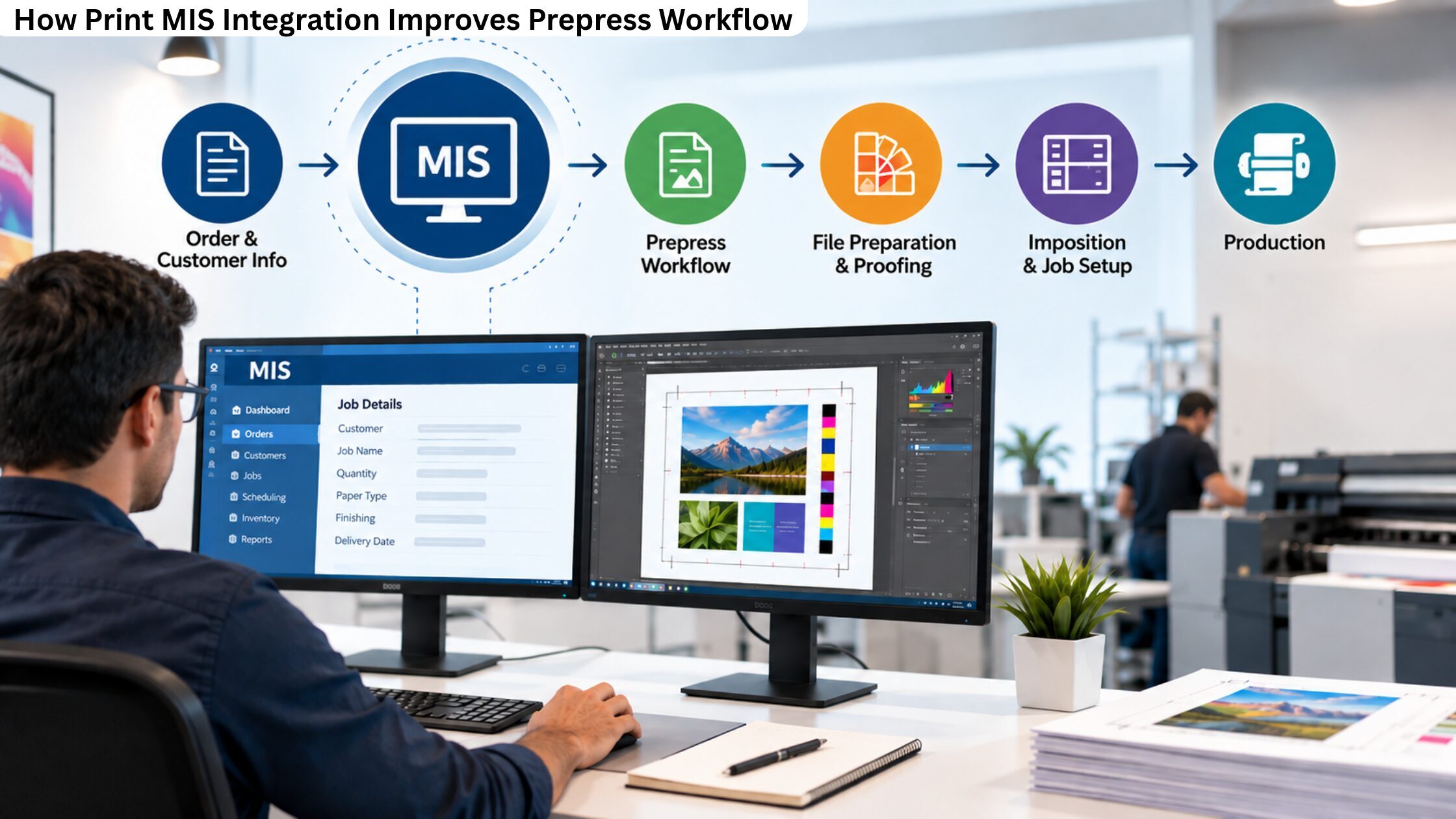
Know how print MIS integration improves prepress workflow. Learn the vital role a prepress service provider plays in improving print quality.
Designers want to deliver print designs on time and with higher accuracy. But every print job comes with customer expectations, tight deadlines, and many details th at require careful coordination. Even today, many print businesses continue using manual methods to share job information between departments.
This can lead to specification oversights, incorrect files going to production, delayed delivery, and extra rework costs. Print MIS integration is a strong solution that connects business processes with prepress services.
According to Smithers, automation continues to play a major role in improving productivity and reducing operating costs across commercial printing. This blog examines how print MIS integration improves prepress workflows.
Why Prepress Workflows Often Delay Production
Before sending a print job to production, prepress workflows require several steps for each job. The crew examines and corrects the customer's artwork. Afterward, the crew inspects the colors and completes imposition and proofing. The following difficulties could occur:
Production schedules become harder to manage.
Customer information may need to be entered multiple times.
Important job specifications can be overlooked.
Incorrect files may be sent to production.
Employees often waste time searching for the correct artwork files.
Even small planning mistakes can affect the rest of the production process.
One minor mistake in the prepress stage can cause delays and increase costs later. Improving communication between systems is a great way to keep production flowing.
What Is Print MIS Integration?
Print MIS integration connects management information system software with different stages of the printing workflow. Instead of managing estimating, scheduling artwork, job tickets, and production as separate activities, all processes work together through one connected system.
Users won't have to enter the same information repeatedly. This is because all users share one common record. No duplication occurs because everyone accesses the same record.
How Does Integration Simplify Prepress Operations?
One of the biggest benefits of Print MIS integration is removing repetitive manual work. The system automatically transfers customer instructions, artwork versions, job specifications, and production requirements from the MIS into modern prepress software.
Integrating the production workflow reduces the time between order entry and production.
Operators no longer have to search through multiple spreadsheets to find job data. Integrating job data enables faster job setup, better coordination across departments, and improved overall accuracy.
A packaging printer producing folding cartons may automatically send approved artwork from MIS to Esko Automation Engine, eliminating manual job creation.
Faster Job Setup With Prepress Workflow Automation
Preparing print files manually can take significant time, especially for companies handling hundreds of print jobs every week. With prepress workflow automation, many routine tasks are completed automatically. These processes include:
Sending notifications to production teams.
Creating job tickets.
Routing files to the correct department.
Assigning production workflows.
Applying predefined print settings.
Generating proofs.
Automation allows prepress professionals to spend more time focusing on quality instead of repetitive administrative work. As print volumes continue to grow, these efficiency gains become even more valuable.
Customers create jobs automatically in MIS through web-to-print portals. The system routes files to prepress and produces print descriptions and an electronic proof without human assistance.
Better Accuracy Through Automated Job Processing
Each time information is entered manually, the possibility of errors increases.
A customer may request coated paper, but the team selects plain paper.
An outdated artwork file may be used for printing.
A finishing instruction can easily be missed.
Although these errors may seem small, they can become expensive very quickly. Automated job processing reduces these risks by transferring job information directly from the MIS into the production workflow.
Entering information once improves consistency at every stage. Customers get the right product, and businesses avoid rework.
Improved Artwork Management
Managing artwork is a big part of prepress work. Files can get misplaced because customers approve files in multiple stages. Files get saved in different formats, and some customers send artwork that requires color adjustments.
Using integrated workflows prevents disorganization. Every file associated with the job is maintained with that job throughout the production process. Instead of searching through numerous emails and shared folders, employees can quickly access the latest approved artwork.
Version control also becomes easier, reducing the risk of printing outdated files. Better organization saves valuable time while increasing customer confidence in the printing process.
More Efficient Print Production Management
Typically, five departments are involved in a print job: Estimating, Prepress, Customer Service, Production, and Shipping. Working in silos causes frustration and wastes time for everyone involved. Without integration, departments will work in separation.
Integrated print production management provides every department with access to the same real-time information. Managers can usually monitor multiple things:
Inventory visibility.
Delivery timelines.
Customer updates.
Progress on tasks.
Set production deadlines.
Proof approval status.
When teams can see the process, they can prioritize activities, reduce the impact of time constraints, and meet deadlines with the right quality.
Improving Print Production Efficiency
Every minute wasted costs profit. For instance, lost productivity can come from waiting for job approvals or searching for missing files. Integrated workflows can eliminate losses from production delays and help streamline print production. Integrated prepress workflows help operators spend less time dealing with paperwork and more time producing quality print work by eliminating production delays.
When each process step is completed, the press runs efficiently and smoothly. These improvements increase productivity by helping businesses produce consistently high-quality work at higher volumes day in and day out.
Supporting Print Job Automation
Print businesses currently handle hundreds or thousands of orders each month. As print job volume grows, handling every production task becomes nearly impossible. An automated print job management system makes it easier to manage jobs and standardize workflows.
You can automate a production system for every type of printing product, such as catalogs, brochures, business cards, labels, and more. As soon as a new order enters the system, the appropriate workflow begins automatically.
This consistent approach improves turnaround times, reduces manual effort, and lets staff focus on higher-value tasks instead of repetitive administrative work.
Choosing The Right Print MIS Software
Every business has different operational requirements, which means not all print MIS software solutions offer the same capabilities. When comparing available systems, businesses should evaluate features such as:
Integration with existing prepress applications.
Print job tracking.
Automation tools for workflow.
Reporting tools and analytics.
Artwork support tools.
User-friendly interface.
Customer training and support.
Scalable architecture for growing businesses.
Selecting software that aligns with existing production processes makes practical implementation much smoother. It minimizes disruption while helping employees adapt more quickly to the new workflow.
Working With An Experienced Prepress Service Provider
Modern technology matters, but it cannot solve everything. An experienced prepress service provider has the skills to configure workflows, automation rules, and production systems.
With the right technical skills and knowledge, businesses can build the systems they need to run their operations more efficiently.
These types of prepress service providers assist businesses by:
Standardizing quality output.
Improving workflow efficiency.
Reducing the need for workflow management.
Improving input file accuracy.
Increasing production speed.
Integrating their software with the ERP system of the business.
With their workflow automation expertise, businesses can minimize implementation challenges and realize long-term benefits that support operations over time.
Develop Faster and Smarter Prepress Workflow Using Essential Prepress Solutions
Linking business management concepts with production processes makes the printing process more efficient. With Print MIS integration, communication becomes more efficient and manual operations are reduced, while prepress workflow is optimized from job receipt through the end of production.
When job processing, prepress workflow automation, and print production management are used together with efficient prepress solutions, the result is increased efficiency and customer satisfaction, along with improved work quality.